Insurance Marketing Systems: The Complete Guide
Most articles about insurance marketing systems list the same four types: independent agency, exclusive agency, direct response, and bancassurance. They explain the structure. They describe the hierarchy. But they don't tell you which system actually works in 2025.
The truth: traditional marketing systems are broken. They're expensive. They're inefficient. They convert at 2-5%. Modern agents who understand this have moved beyond the old models. They've built branded lead generation systems that convert at 25-40%.
Insurance marketing systems are the organizational structures and distribution channels that connect insurance carriers with agents and customers. Traditional systems include independent agency (agents represent multiple carriers), exclusive agency (agents represent one carrier), direct response (no agents), and bancassurance (insurance through banks). Modern systems use branded lead generation where prospects watch agent videos before booking, resulting in 5-10x higher conversion rates than traditional methods.
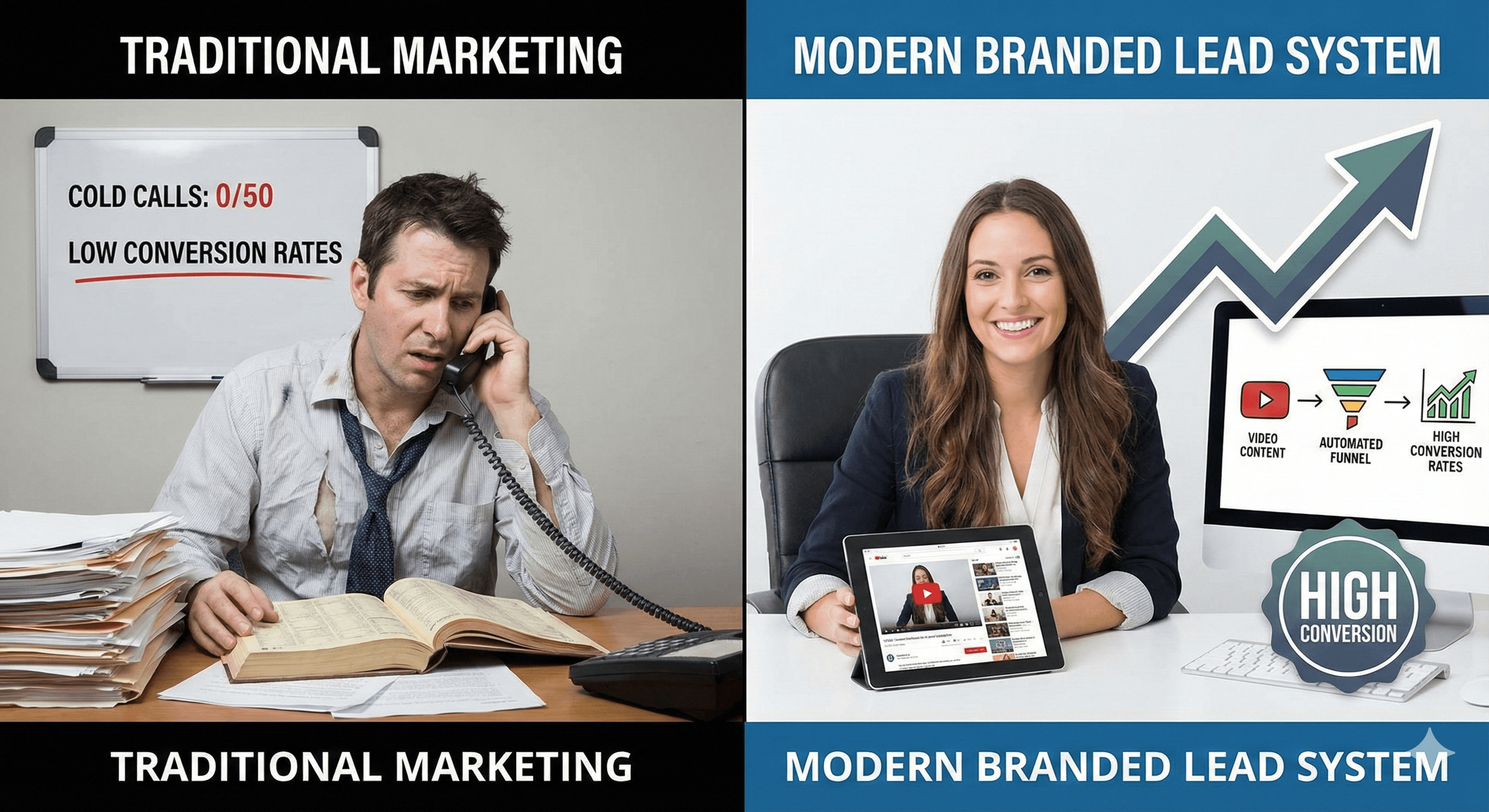
The old systems don't work anymore. Here's what does.
The Four Traditional Insurance Marketing Systems
Let's cover the basics first. You need to understand what exists before you can understand what's better.
1. Independent Agency System
Independent agents represent multiple insurance carriers. They own their book of business. They can move policies between carriers if needed. They earn higher commissions but pay their own expenses.
How it works:
The agent signs contracts with multiple carriers. When a prospect needs insurance, the agent shops around. They find the best policy for the client. The agent earns a commission from the carrier.
The math:
- Commission: 10-15% of first-year premium
- Expenses: Agent pays for office, staff, marketing
- Renewal rights: Agent owns the business
- Flexibility: Can switch carriers if needed
The problem:
Independent agents still face the same challenge: finding clients. Having multiple carriers doesn't solve the lead generation problem. You still need to market yourself. Most independent agents end up buying shared leads or cold calling. The system structure doesn't change the fundamental marketing challenge.
2. Exclusive Agency System
Exclusive agents represent one carrier or a group of related carriers. The carrier provides support: office space, training, marketing materials. The agent earns lower commissions but has fewer expenses.
How it works:
The agent signs an exclusive contract. They can only sell that carrier's products. The carrier provides resources. The agent focuses on selling. The carrier owns the book of business.
The math:
- Commission: 5-10% of first-year premium
- Expenses: Carrier pays for office, training, marketing
- Renewal rights: Carrier owns the business
- Flexibility: Cannot switch carriers easily
The problem:
Exclusive agents have the same marketing challenge. Carrier support doesn't mean carrier-generated leads. You still need to find prospects. You still need to convert them. The carrier provides tools, not clients.
3. Direct Response System
Direct response eliminates agents entirely. The carrier markets directly to consumers through advertising, websites, and call centers. Policies are sold online or over the phone.
How it works:
The carrier creates marketing campaigns. Consumers see ads. They visit the website. They buy policies directly. No agent involved.
The math:
- Commission: None (no agents)
- Expenses: Carrier pays for all marketing
- Customer acquisition: $200-500 per policy
- Conversion rate: 1-3% of website visitors
The problem:
Direct response works for simple products (term life, auto insurance). It doesn't work for complex products that need explanation. Most consumers want to talk to someone before buying life insurance. Direct response can't provide that personal touch.
4. Bancassurance
Bancassurance is insurance sold through banks. The bank partners with an insurance carrier. Bank customers can buy insurance when they visit the branch or apply for loans.
How it works:
The bank and carrier form a partnership. Bank employees are trained to sell insurance. Customers are offered policies during banking interactions. The bank earns a commission or fee.
The math:
- Commission: Shared between bank and carrier
- Customer acquisition: Low (existing bank customers)
- Conversion rate: 2-5% of bank customers
- Products: Usually simple (credit life, term life)
The problem:
Bancassurance is limited. You can't use it unless you're a bank or partner with one. It's not a system individual agents can adopt. It's a distribution channel for carriers, not a marketing system for agents.
The FMO, IMO, MGA Hierarchy Explained
Many agents get confused by the acronyms. Here's the simple breakdown:
FMO (Field Marketing Organization):
Top-level organization. Contracts directly with carriers. Works with hundreds to thousands of agents. Licensed in most or all states. Offers training, support, and technology. Agents may need production requirements to maintain commission levels.
IMO (Independent Marketing Organization):
Similar to FMO. Sometimes smaller. May focus on life insurance (while FMOs focus on health). Same structure: contracts with carriers, works with many agents, provides support.
MGA (Managing General Agent):
Mid-level organization. Contracts under an FMO or IMO. Manages their own downline agents. Earns commission plus overrides. May have production requirements. Provides training to their agents.
GA (General Agent):
Lower-level organization. Contracts under an FMO, IMO, or MGA. May have their own sub-agents. Lower production requirements. Less support than higher levels.
The reality:
The hierarchy affects your commission and support. It doesn't affect your marketing challenge. Whether you're with an FMO or a GA, you still need to find clients. The organization structure doesn't generate leads. You do.
Why Traditional Systems Fail Modern Agents
Traditional marketing systems were designed for a different era. They assume agents will:
- Cold call prospects
- Attend networking events
- Ask for referrals
- Buy shared leads
These methods worked in 2010. They don't work in 2025.
The cold calling problem:
You're calling strangers. They don't know you. They're busy. They're skeptical. Even if you're good, your conversion rate is 2-3%. That means 97 out of 100 calls are wasted time.
The networking problem:
Networking events cost money and time. You meet 20 people. Maybe 2 are qualified. Maybe 1 becomes a client. Your cost per acquisition: $2,000-$5,000. That's not scalable.
The referral problem:
Referrals are great when they happen. But you can't control when they happen. You can't scale them. Most agents get 1-2 referrals per month. That's not enough to grow.
The shared lead problem:
You buy a lead for $50-$200. Five other agents bought the same lead. The prospect gets six calls in one day. They're annoyed. Your contact rate is 10-20%. Your conversion rate is 2-5%. Your cost per client: $2,000-$10,000.
The problem isn't the system structure. It's the marketing method. Traditional systems don't solve the fundamental challenge: how do you find qualified prospects who trust you before you call them?
The Modern System: Branded Lead Generation
Top agents have moved beyond traditional systems. They've built branded lead generation systems. These systems work differently.
The core principle:
Prospects must know you, like you, and trust you before you ask for their contact information. This eliminates cold objections. It increases show rates. It dramatically improves close rates.
How it works:
Phase 1: Trust Building at Scale
You run short-form video ads (30-90 seconds) on Facebook, Instagram, and TikTok. These aren't sales pitches. They're micro-educational moments that position you as the expert.
Example: "Most people don't realize their employer's life insurance only covers 1-2x their salary. If you make $75,000, that's $75,000-$150,000 in coverage. But your family needs 10x your income to maintain their lifestyle. Here's how to calculate what you actually need..."
The ad doesn't sell. It educates. It builds authority. It creates curiosity.
Prospects who watch 10-15 of these ads start recognizing your face, your voice, your expertise. When they see your booking page, they're not thinking "Who is this agent?" They're thinking "I've seen this agent before. They know what they're talking about."
Use our Free Agent Ad Scripts to get started. These scripts are designed to be filmed in minutes and address specific client pain points.
Phase 2: The Conversion Funnel
Your video ads drive to a dedicated landing page. The page has one job: capture contact information in exchange for a high-value offer.
The offer formula:
- Specific (not "Free Consultation")
- Valuable (solves a real problem)
- Low commitment (doesn't require a sales call)
Examples:
- "Get Your Free Life Insurance Needs Calculator: See How Much Coverage You Actually Need"
- "Download: The 5 Questions Every Parent Should Ask Before Buying Life Insurance"
- "Free Analysis: How Much Life Insurance Do You Really Need? (Calculator Included)"
The page includes social proof, addresses objections, and has a single, clear call-to-action.
Phase 3: Automated Nurture Sequence
Once a prospect enters your system, automation takes over. They receive a sequence of emails and text messages that:
- Deliver the promised content
- Answer common questions
- Pre-frame the sales conversation
- Build urgency without being pushy
This sequence runs 24/7. You're not manually following up. The system is working while you sleep.
Phase 4: The Warm Appointment
By the time a prospect books a call with you, they've:
- Watched 10-15 of your videos
- Consumed your educational content
- Received multiple touchpoints from your automated sequence
- Self-qualified by taking action
You're not making a cold call. You're having a consultation with someone who already trusts you.
The results:
- Show rate: 85-95% (vs. 30-40% for cold leads)
- Close rate: 40-60% (vs. 5-15% for cold leads)
- Cost per client: $100-300 (vs. $2,500-$5,000 for cold leads)

The math doesn't lie. Branded leads convert 5-10x higher than traditional systems.
The Math That Changes Everything
Let's compare the two models:
Traditional Marketing System (50 leads/month):
- Cost: $5,000/month (buying shared leads)
- Time: 150 hours/month (calling, following up, meeting)
- Contacts: 12-18 made
- Appointments: 4-7 booked
- Clients: 1-2 closed
- Cost per client: $2,500-$5,000
- Effective hourly rate: $33-$67
Branded Lead Generation System (Optimized):
- Cost: $3,000-5,000/month (ad spend + service/education)
- Time: 5-10 hours/month (mostly closing)
- Contacts: 20-30 made
- Appointments: 15-25 booked
- Clients: 10-20 closed
- Cost per client: $150-500
- Effective hourly rate: $300-$600
The branded system costs similar upfront but delivers 10x the ROI. More importantly, it's an asset. Every month you run it, you're building a database of warm prospects, improving your ad performance, and creating a predictable revenue stream.
Traditional marketing is a recurring expense with diminishing returns. Branded lead generation is a capital investment that compounds.
How to Choose the Right System for You
The right system depends on your situation:
Choose traditional systems if:
- You have an existing referral network that generates 10+ clients per month
- You enjoy cold calling and networking
- You have unlimited time to spend on low-conversion activities
- You're comfortable with $2,500-5,000 cost per client
Choose branded lead generation if:
- You want predictable, scalable results
- You prefer warm appointments over cold calls
- You want to build a marketing asset, not rent leads
- You want $150-500 cost per client with 25-40% conversion rates
Most agents start with traditional systems because they're familiar. They switch to branded lead generation when they realize the math doesn't work.
The Technology Stack for Modern Marketing Systems
Modern branded lead systems require specific tools:
Video Creation:
- Smartphone camera (that's it)
- Basic editing app (CapCut, InShot)
- Script library (Free Agent Ad Scripts)
Ad Platform:
- Facebook Ads Manager
- Instagram Ads
- TikTok Ads
Funnel Builder:
- Landing page builder (ClickFunnels, Leadpages, or custom)
- Form capture
- Thank you page
Automation:
- Email marketing platform (ConvertKit, Mailchimp, ActiveCampaign)
- SMS platform (Twilio, SimpleTexting)
- Calendar booking (Calendly, Acuity)
Analytics:
- Facebook Pixel
- Google Analytics
- Conversion tracking
You don't need all of these immediately. Start with video creation and ad platform. Add the rest as you scale.
Common Mistakes Agents Make with Marketing Systems
Mistake #1: Confusing System Structure with Marketing Method
Having an FMO contract doesn't generate leads. Having an exclusive agency doesn't generate leads. The system structure is just the framework. You still need a marketing method that works.
Mistake #2: Trying to Do Everything Yourself
You can't be an expert at life insurance, marketing, ad creation, funnel building, and automation. Either invest in education to learn the system or invest in a service to run it for you.
Mistake #3: Expecting Immediate Results
Traditional marketing shows results in days (bad results, but results). Branded lead generation takes 30-60 days to optimize. Most agents quit before the system has time to work.
Mistake #4: Not Tracking the Right Metrics
Cost per lead is a vanity metric. Cost per client is what matters. Show rate, close rate, lifetime value—these are the numbers that determine if your system is working.
Mistake #5: Ignoring Lifetime Value
A client who buys a $500,000 policy and refers 3 friends is worth more than a client who buys a $100,000 policy once. Branded leads tend to have higher lifetime value because they're more engaged and more likely to refer.
The Bottom Line: System Structure vs. Marketing Method
Insurance marketing systems are just organizational structures. They define how you contract with carriers. They don't define how you find clients.
The real question isn't which system structure to choose. It's which marketing method to use.
Traditional methods (cold calling, networking, shared leads) convert at 2-5% and cost $2,500-5,000 per client. Modern methods (branded lead generation) convert at 25-40% and cost $150-500 per client.
The system structure (FMO, IMO, MGA, independent, exclusive) is just the framework. The marketing method is what determines your success.
If you're ready to move beyond traditional systems and build a branded lead generation system, get our free ad scripts to see how it works. Or explore our done-for-you service if you want results without the learning curve.
The old systems don't work anymore. The new system is here. The only question is: when are you going to make the switch?