Life Insurance Lead Generation: Complete Framework
Most life insurance agents think a "lead generation system" means buying a CRM and dialing faster. That's not a system. That's expensive busywork.
The agents closing 50+ policies per year aren't working harder. They're running systems that work while they sleep. These systems attract prospects who already know their name, trust their expertise, and want to work with them specifically. The difference isn't talent—it's architecture.
A life insurance lead generation system is a complete, automated framework that attracts, nurtures, and converts prospects into clients without manual cold calling. It uses branded video ads to build trust at scale, conversion funnels to capture contact information, and automated sequences to nurture relationships. Unlike buying shared leads where agents compete for cold prospects, a proper system generates exclusive, warm appointments with 40-60% close rates versus the industry standard 5-15%.

The difference between a system and an activity: one scales, the other burns out.
Why "Lead Generation" Isn't the Problem
Most agents focus on the wrong question. They ask "How do I get more leads?" The real question is "How do I build a system that generates qualified appointments predictably?"
The Lead Buying Trap:
You buy 100 leads for $2,500. Five other agents bought the same leads. You make 30-40 contacts. You book 10-18 appointments. You close 1-3 sales. Your cost per sale: $833-$2,500.
But here's what most agents miss: you're not just paying for leads. You're paying for a model that can't scale. Every lead requires manual work. Every call is cold. Every follow-up is manual. You're trading time for money, and time doesn't scale.
The System Approach:
You invest $3,000-5,000 monthly in a branded lead system. The system runs 24/7. Prospects watch your videos. They book appointments. They show up pre-sold. You close 15-30 sales monthly. Your cost per sale: $100-300.
The difference isn't the leads. It's the system. One model requires you to work harder. The other model works harder for you.
The Four Components of a Complete Lead Generation System
A true system has four components. Most agents skip components. They run ads without funnels. They build funnels without automation. They automate without tracking. Missing one component breaks the entire system.
Component 1: Trust Building at Scale (Video Ads)
Your system starts with video ads. Not blog posts. Not LinkedIn updates. Video ads.
Why Video Works:
The human brain processes video 60,000 times faster than text. A 30-second video can communicate what takes 1,000 words to explain. More importantly, video creates familiarity. When prospects see your face 10-15 times before booking, you're not a stranger. You're a trusted advisor.
The Ad Strategy:
Run short-form video ads (30-90 seconds) on Facebook, Instagram, and TikTok. These aren't sales pitches. They're micro-educational moments.
Example script:
"Most people think their employer's life insurance is enough. It's not. If you make $75,000, your employer probably covers $75,000-$150,000. But your family needs 10x your income to maintain their lifestyle. Here's how to calculate what you actually need..."
The ad educates. It builds authority. It creates curiosity. It doesn't sell.
The Frequency Rule:
Prospects need to see your ads 10-15 times before they book. This isn't optional. It's neuroscience. Familiarity breeds trust. Trust breeds action. One ad won't do it. You need a campaign that runs consistently.
Use our Free Agent Ad Scripts to get started. These scripts are designed to be filmed in minutes and address specific client pain points.
Component 2: The Conversion Funnel
Your video ads need a destination. This isn't your website homepage. It's a dedicated landing page with one job: capture contact information.
The Landing Page Formula:
- Headline: Mirrors the promise of your ad
- Subheadline: Explains the specific benefit
- Social Proof: Testimonials or case studies
- The Offer: High-value content in exchange for contact info
- The Form: Name, email, phone (keep it simple)
- The CTA: Single, clear call-to-action
The Offer Strategy:
Your offer must be:
- Specific: Not "Free Consultation" but "Free Life Insurance Policy Audit"
- Valuable: Solves a real problem they have right now
- Low Commitment: Doesn't require a sales call to receive
Examples:
- "Get Your Free Life Insurance Needs Calculator: See How Much Coverage You Actually Need"
- "Download: The 5 Questions Every Parent Should Ask Before Buying Life Insurance"
- "Free Analysis: How Much Life Insurance Do You Really Need? (Calculator Included)"
The Objection Handling:
Address the three main objections on your landing page:
- "I don't have time" → "Takes 5 minutes. Get your results instantly."
- "I'll be sold to" → "No sales pitch. Just your personalized analysis."
- "I already have insurance" → "Most people are underinsured. See if you're one of them."
Component 3: Automated Nurture Sequence
Once a prospect enters your system, automation takes over. This is where most agents fail. They capture leads but don't nurture them. They send one email and give up.
The Sequence Structure:
Your automated sequence should have 5-7 touchpoints over 14-21 days:
Email 1 (Immediate): Deliver the promised content Email 2 (Day 2): Answer a common question Email 3 (Day 4): Share a case study or testimonial Email 4 (Day 7): Address a specific objection Email 5 (Day 10): Invite to book a consultation Email 6 (Day 14): Create urgency (limited availability) Email 7 (Day 21): Final invitation with social proof
The Message Strategy:
Each email should:
- Provide value (don't just sell)
- Build trust (share expertise)
- Create curiosity (tease what they'll learn)
- Include a clear CTA (book a call)
The Multi-Channel Approach:
Don't rely on email alone. Use SMS for high-intent prospects. Use retargeting ads for website visitors who didn't convert. Use multiple channels to stay top-of-mind.
Component 4: Tracking and Optimization
A system without tracking is just hope. You need to measure everything.
The Key Metrics:
- Cost Per Click (CPC): How much you pay for each ad click
- Click-Through Rate (CTR): Percentage of people who click your ad
- Conversion Rate: Percentage of visitors who fill out your form
- Cost Per Lead (CPL): Total ad spend divided by leads generated
- Show Rate: Percentage of booked appointments that actually show
- Close Rate: Percentage of appointments that become clients
- Cost Per Client (CPC): Total system cost divided by clients closed
- Lifetime Value (LTV): Total revenue from a client over time
The Optimization Process:
Week 1-2: Launch and collect data Week 3-4: Identify underperforming ads and pause them Week 5-6: Double down on winning ads Week 7-8: Test new ad variations Week 9+: Scale what works, kill what doesn't
The Rule of 3:
Test three variations of everything:
- Three ad headlines
- Three landing page offers
- Three email subject lines
- Three CTA buttons
The winner gets the budget. The losers get paused. This is how you optimize.
The Math That Proves the System Works
Let's compare two models:
Model 1: Buying Shared Leads (Traditional)
- Monthly investment: $2,500 (100 leads at $25 each)
- Time investment: 200 hours (2 hours per lead)
- Contacts made: 30-40 (30-40% contact rate)
- Appointments booked: 10-18 (35-45% show rate)
- Clients closed: 1-3 (5-15% close rate)
- Cost per client: $833-$2,500
- Effective hourly rate: $12.50-$25
Model 2: Branded Lead Generation System (Modern)
- Monthly investment: $3,000-5,000 (ad spend + service/education)
- Time investment: 5-10 hours (mostly closing)
- Contacts made: 20-30 (system pre-qualifies)
- Appointments booked: 15-25 (85-95% show rate)
- Clients closed: 10-20 (40-60% close rate)
- Cost per client: $150-500
- Effective hourly rate: $300-$600
The branded system costs similar upfront but delivers 10x the ROI. More importantly, it's an asset. Every month you run it, you're:
- Building a database of warm prospects
- Improving your ad performance
- Creating a predictable revenue stream
- Scaling without hiring
Traditional lead buying is a recurring expense. The system is a capital investment that compounds.
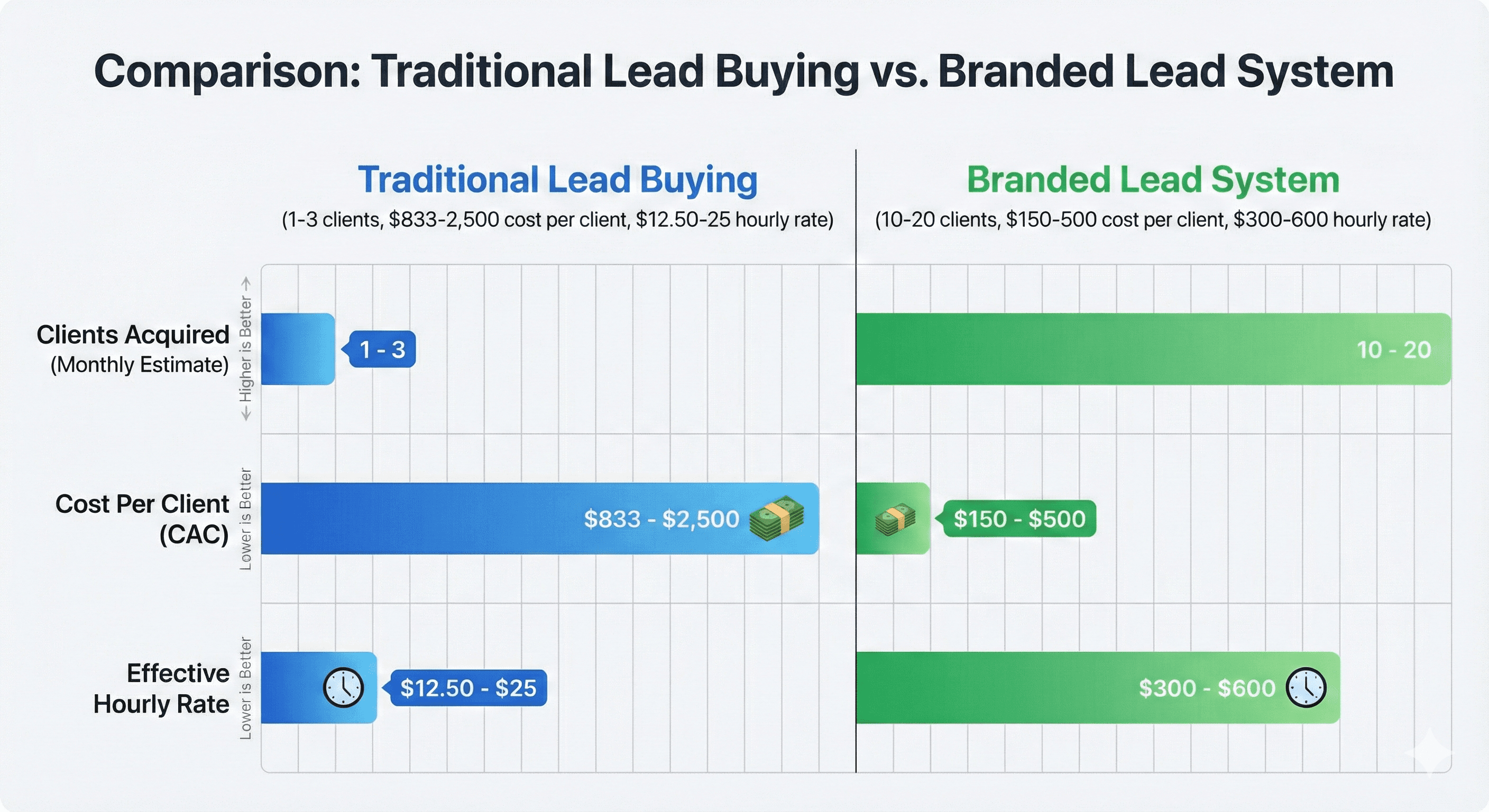
The math doesn't lie. Systems outperform activities every time.
The Implementation Timeline
Building a complete system takes time. Here's what to expect:
Days 1-7: Foundation
- Set up ad accounts (Facebook, Instagram, TikTok)
- Create landing page
- Build email sequence
- Install tracking pixels
- Create first 5-10 video ads
Days 8-30: Launch and Learn
- Launch ad campaigns
- Monitor daily performance
- Collect initial data
- Make first optimizations
- Book first appointments
Days 31-60: Optimization
- Identify winning ads
- Pause underperformers
- Test new variations
- Refine landing page
- Improve email sequence
Days 61-90: Scale
- Double down on winners
- Increase ad spend
- Expand to new platforms
- Build additional funnels
- Systemize everything
Day 91+: Compound
- System runs 24/7
- You focus on closing
- Monthly optimizations
- Continuous improvement
- Predictable revenue
Most agents quit at day 30. They see initial results and think it's not working. But systems compound. The first 30 days are learning. Days 31-60 are optimization. Days 61-90 are scaling. Day 91+ is compounding.
The Two Paths to Building Your System
You have two options:
Path 1: Learn and Build It Yourself
This path requires investing in education and dedicating 10-20 hours weekly for 60-90 days. You learn ad platforms, copywriting, funnel building, and automation. The upfront cost is time, but you own the system forever.
Our S.C.A.L.E. course teaches life insurance professionals the complete framework for building branded lead systems. You learn how to create video ads, build funnels, set up automation, and optimize for ROI. It's the most powerful long-term investment you can make in your practice.
Timeline: 60-90 days to see consistent results Investment: Education cost + ad spend ($2,000-5,000/month) ROI: Once optimized, you own a system that generates leads for years
Path 2: Done-For-You Service
If you need results faster and have the capital, a done-for-you service builds and manages the entire system for you. You receive exclusive, warm appointments directly in your calendar. You focus on closing, not learning marketing.
We offer a done-for-you branded lead service that handles everything: ad creation, funnel building, automation setup, and optimization. You get the system without the learning curve.
Timeline: 30-60 days to see consistent results Investment: Monthly service fee + ad spend ROI: Predictable cost-per-acquisition with minimal time investment
Both paths work. The choice depends on your timeline, capital, and long-term goals. But both paths lead to the same destination: owning a system instead of renting one.
The Five Fatal Mistakes Most Agents Make
Mistake #1: Building Components, Not Systems
Creating video ads without a funnel is just content creation. Building a funnel without automation is just a website. Automating without tracking is just hope. You need all four components working together.
Mistake #2: Optimizing for the Wrong Metrics
Cost per lead is a vanity metric. Cost per client is what matters. Show rate, close rate, lifetime value—these are the numbers that determine if your system is working. Track everything. Optimize what matters.
Mistake #3: Quitting Before the System Compounds
Most agents see initial results and think it's not working. But systems take 60-90 days to optimize. The first month is learning. The second month is optimization. The third month is scaling. Month four+ is compounding. Patience compounds.
Mistake #4: Trying to Do Everything Yourself
You can't be an expert at life insurance sales, marketing, ad creation, funnel building, and automation. Either invest in education to learn the system or invest in a service to run it for you. Trying to do it all yourself with YouTube tutorials leads to expensive mistakes.
Mistake #5: Not Factoring Lifetime Value
A client who buys a $500,000 policy and refers 3 friends is worth more than a client who buys a $100,000 policy once. Branded leads tend to have higher lifetime value because they're more engaged, more trusting, and more likely to refer. Factor lifetime value into your cost-per-acquisition calculations.
The System vs. The Activity
Most agents confuse activities with systems. Here's the difference:
Activity: Making 100 cold calls per day System: Automated ads that generate 10 warm appointments per week
Activity: Attending networking events monthly System: Video ads that reach 50,000 prospects monthly
Activity: Posting on LinkedIn daily System: Automated sequence that nurtures 200 prospects simultaneously
Activity: Asking for referrals from clients System: Automated referral program that incentivizes and tracks referrals
Activities require you to work. Systems work for you. Activities don't scale. Systems scale infinitely. Activities burn out. Systems compound.
The Bottom Line: Build Assets, Not Expenses
A life insurance lead generation system isn't a marketing tactic. It's a business asset. Every month you run it, you're:
- Building a database of warm prospects
- Improving your ad performance
- Creating predictable revenue
- Scaling without hiring
- Compounding your results
Buying leads is an expense. Building a system is an investment. Expenses drain. Investments compound.
The agents closing 50+ policies per year aren't working harder. They're running better systems. They're building assets instead of paying for commodities.
The question isn't whether you can afford to build a branded lead system. It's whether you can afford not to.
If you're ready to stop buying leads and start building a system, get our free ad scripts to see how it works. Or explore our done-for-you service if you want results without the learning curve.
The old model is broken. The new model is here. The only question is: when are you going to make the switch?